
(1 + i) ÷ √(2) = √(2)/2 + √(2)/2i;
arg(1 + i) = 45° & arg(√(2)/2 + √(2)/2i) = 45°
(3 + 4i) ÷ 5 = 3/5 + 4/5i;
arg(3 + 4i) = 53.13010235...° & arg(3/5 + 4/5i) = 53.13010235...°
(They're the exact same irrational number of degrees, even though you can't see all the digits! There are far too many digits to count after the decimal point anyway; in fact, there's infinitely many!)
(-(4 + 1/2) - 9√(3)/2i) ÷ 9 = -1/2 - √(3)/2i;
arg(-9/2 - 9√(3)/2i) = -120° & arg(-1/2 - √(3)/2i) = -120°
Note: If you go counterclockwise instead of clockwise with this last example, the angle (or argument) is 240°. Graphing calculators refer to the clockwise angle when complex numbers are in Quadrants III or IV! Also, I typed the mixed number as an improper fraction for simplification! (-(4 + 1/2) = -9/2)
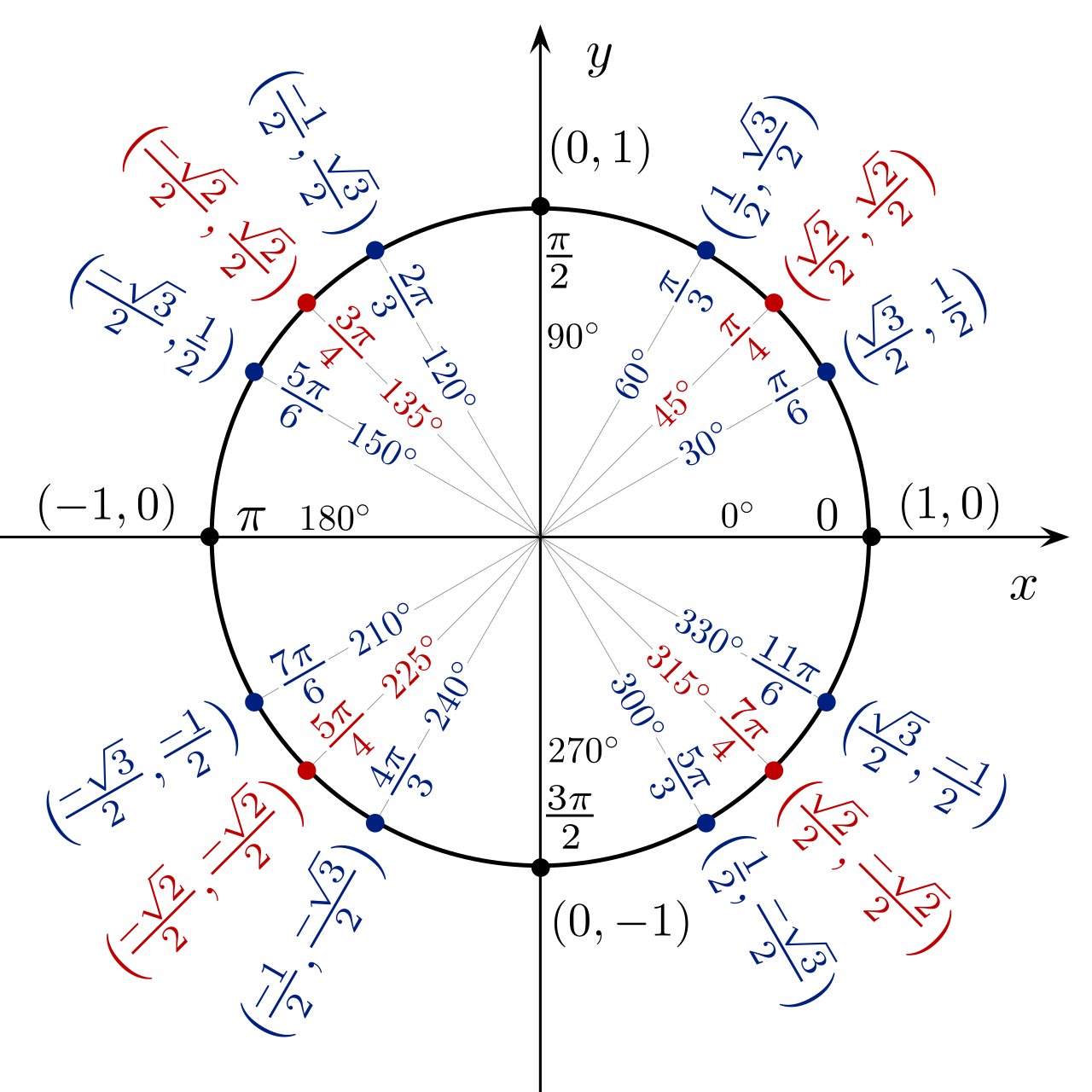
Each point shows you the rectangular coordinates, which is how long the vertical & horizontal sides of a right triangle would be if its hypotenuse was 1 unit long. Both rectangular coordinates are positive in Quadrant I, which is the one at the top right; although at least 1 of them is negative in the other quadrants, it doesn't affect the absolute values of the sides of the imaginary right triangle. A minus sign(-) simply means that the length goes in the opposite direction! Also, the angles (also known as arguments) of the complex numbers are shown in both radians & degrees. (Angles shown in radians often include the irrational number known as pi(π) in their expressions! That's because they're based on the formula for the circumference of a circle in terms of the radius.)


Back to Index Page Back to Math Trick Menu
© Derek Cumberbatch