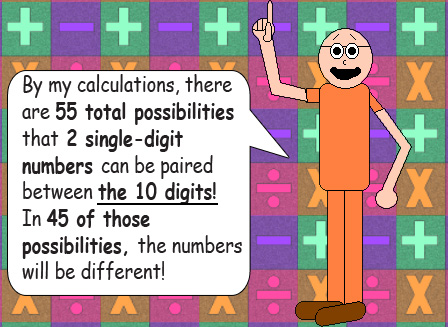
You can tell what the 1st digit will be in the correct answer of a math problem, especially if it's simple addition or multiplication. All you got to do is remember the basics. Whenever you forget the basics, however, you can review this Web page for necessary hints!
By the way, Dr. John Von Foolish forgot to mention that the order of the 2 numbers doesn't matter because they're combinations!
Because zero is the additive identity & the number of emptiness.
The sentence for the previous possibility of 2 single-digit numbers explains this, too!
But when we get to nine(9), however...
This is the 1st possibility of 2 single-digit numbers that has a 2-digit sum! Whenever the sum is greater than or equal to ten(10), you'll have a 2nd digit to carry to the next column of digits. (It'll always be a one in addition)
Eighteen(18) is the biggest possible number that you can get in addition with 2 single-digit numbers! (Probably because 9 * 2 = 18 & 9 is the biggest single-digit number! Also, adding a number to itself is the same as multiplying it by 2.)
Because multiplication by zero always gives you zero as the product!
Because one(1) is the number of multiplicative identity.
Multiplication by two(2) will ALWAYS give you an even number if & only if the multiplicand is an integer!
But hold on a second! The 1st possibility of 2 single-digit numbers that has a 2-digit product is 2 * 5 = 10.
I just thought of this theory: The bigger the single-digit number is, the more likely that the sum or product will have 2 digits! In such a case, you'll have a 2nd digit to carry to calculate for the next digit column after the ones' column. Think about this with numbers that have more than 1 digit in math problems. You'll ALWAYS have to add that carried digit to the sum or product of the next column. In multiplication, however, remember to shift to the next power of 10 when the multiplier has several digits. You'll eventually have to do addition in the end since multiplication is glorified addition.
Multiplication by five(5) will give you a zero in the ones' column if you multiply it by an even number; you'll get a five in that same 1st column if you multiply it by an odd number. The only time you won't have to carry a 2nd digit to the next column is if you multiply it by one(1) or zero(0). Excluding the digit zero(0), five(5) is the average-sized digit!
And here's the biggest possible product between 2 single-digit numbers! Notice how the digits are in reverse order compared to 18. Remember that multiplying a number by itself is the same as squaring it.

Miss One representing the number one(1) again, but actually, zero(0) is the smallest whole number; the set of whole numbers includes zero but the set of natural numbers does not. (You already know that zero is less than one!) Neither set includes negative numbers, however, negative numbers are just the additive inverses of positive numbers! But negative numbers are out of the ballpark in this math trick.
Back to Index Page Back to Math Trick Menu
© Derek Cumberbatch